
Case Search Sacramento gives Sacramento residents instant entry to public court records, letting anyone locate a case by name, case number, attorney, or filing date with just a few clicks. By tapping the official online portal, users can filter results by court division, case type, or status, which means a civil case search, criminal case search, or family case search returns only the most relevant entries. The system pulls data directly from the court’s case database, so information such as case title, party names, judge assignment, and filing date appears in real time, helping people verify case details, track recent filings, or explore historical case records. Whether you need to find a probate case, juvenile case, or traffic case, the search engine’s built‑in filters let you narrow results by date range, case status, or specific court, ensuring you see exactly what you need without sifting through unrelated filings.
Case Search Sacramento also supports advanced queries like case search by attorney, case search by party name, and case search by case type, making it simple to locate a specific legal matter or perform a broader case records search. Users can sort results by case number, filing date, or court division, then click into each record for detailed case information, including docket entries and court documents. The platform updates regularly, so the latest case information is available, while historical case records remain accessible for research or reference. By combining user‑friendly navigation with precise filtering, this case search tool eliminates common frustrations such as “case not found” messages or overwhelming result lists, delivering reliable public case records whenever they’re needed.
How to Search Court Cases in Sacramento
Sacramento’s online case search tool helps you locate court records from any computer or phone. The system connects directly to the court’s public case database, including traffic ticket records, so you see the same records a clerk would view. You can look up a case by number, party name, attorney, filing date, court, or case type. Results show in seconds, and you do not need to create an account to start searching.
To begin, open your web browser and go to the court website. Once there, click the “Case Search” link under the online services menu. The next page displays several search fields where you enter the details you already know. If you have a case number, type it in first because numbers give the fastest and most exact results. When you finish, hit the search button, and the system lists matching records.
Official Search Portal: https://www.saccourt.ca.gov/online-services/case-search
Steps to Search
- Open the official Sacramento Superior Court case search portal using the link above.
- Pick a search method such as case number, party name, attorney, filing date, or court division.
- Type the required details into the right field. For names, enter last name first, then first name.
- Select a date range if your search uses dates. Choose a start date and an end date from the calendar tool.
- Choose a case type filter if you want only civil, criminal, family, probate, juvenile, or traffic cases.
- Press the “Search” button to run the query. Wait a few seconds for the results list to load.
- Review the list of matching cases. Click any case title to open the full case information page.
How to Search Court Cases
The Sacramento court search engine accepts seven main search methods. Each method works best for a different type of lookup. Picking the right method saves you time and cuts down on result lists. The table below shows which search field to use for common questions.
Search by Case Number
A case number is a unique code the court assigns when a case opens. It usually contains letters and numbers, like “19CV001234.” Type the full case number into the case number box with no spaces. The system returns one exact match when the number is correct. This is the fastest way to find court records.
Search by Party Name
To search by party name, enter the last name first, followed by a comma, then the first name. You can also use a partial name if you do not know the full spelling. The portal then lists every case where that person appears as plaintiff, defendant, petitioner, respondent, or attorney. This method works for both civil and criminal records.
Search by Attorney Name
If you know the lawyer on a case, type the attorney’s full name in the attorney search field. The portal shows every case filed by that lawyer within the Sacramento court system. This search helps when you track a lawyer’s recent filings or verify a case involves a specific attorney. Partial names also work here.
Search by Filing Date
The filing date search asks you to pick a starting date and an ending date. Use the calendar icons inside the search form to set both dates. The system displays every case filed in that window. This is helpful when you remember the time frame of a hearing or filing but lack other details.
Search by Court or Division
Sacramento’s court has different divisions, such as civil, criminal, family, and probate. Choose a specific division from the court drop-down list to limit results. You can combine this with name or date searches for a narrower match. Each division manages only certain case types.
Search by Case Type
Case type filters remove unrelated categories from your list. Pick from civil, criminal, family, probate, juvenile, misdemeanor, felony, or traffic. When you add a case type to any search, results shrink to only that legal area. This filter is useful for broad name searches that return many hits.
Search by Case Status
Case status tells you if a case is open, closed, or pending. Pick a status from the status drop-down to filter results. Open cases still have activity, while closed cases have final rulings. This filter helps you skip old cases when you want recent activity.
Case Search Results
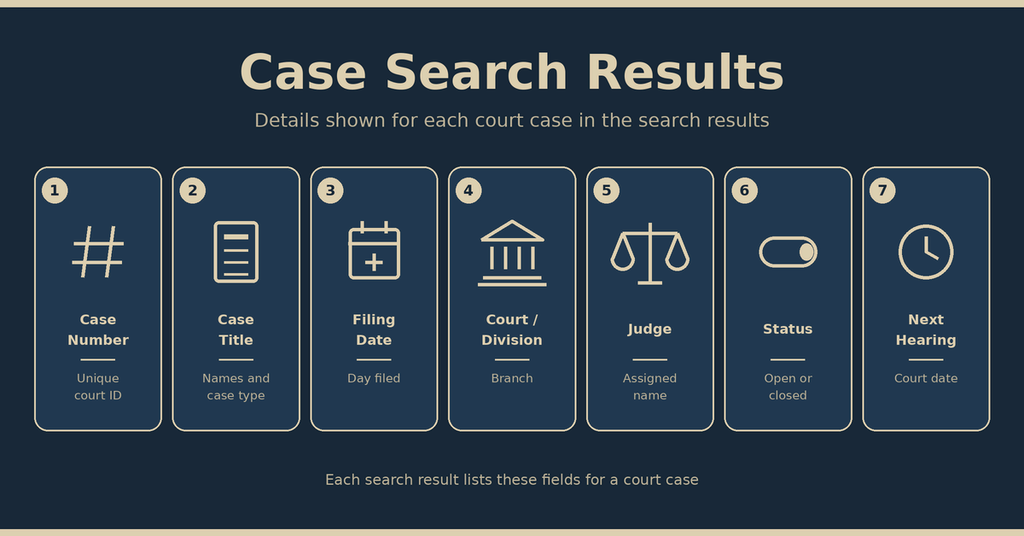
Once you run a search, the portal shows a results table. Each row holds one matching case, and each column shows a key fact. Click any row to open the full case record. The columns display the most useful identifiers at a glance.
Case Number and Case Title
The case number appears at the top of every result. The case title lists the parties, such as “Smith vs. Jones,” followed by the case type. Together, these two fields identify a legal matter without confusion. They also link to the full case detail page when clicked.
Party Names and Roles
Each party shows with a legal role label. You might see plaintiff, defendant, petitioner, or respondent. The same person can hold different roles in different cases. Role tags help you confirm you found the right person before opening full records.
Attorney Information
The attorney of record appears next to the party they represent. This shows who is handling the case right now. If an attorney changed, the older name may still show in past entries. You can click the attorney name to search for other cases they filed.
Court and Judge
The court division appears alongside the assigned judge’s name. Sacramento judges handle cases within specific branches. Knowing the judge helps for scheduling and procedural questions. The court location also tells you where hearings take place.
Filing Date
The filing date marks when the case first began. It often appears near the case number in the results table. Old filing dates mean archived records, while recent dates mean active cases. You can sort results by filing date to see newest cases first.
Case Type
Case type labels sit in a dedicated column. They display terms like civil, criminal, felony, or family. This lets you know the legal area without opening the full file. Type tags also speed up filtering when you only need one category.
Case Status
Status shows the current state of the case. Open, closed, pending, and dismissed are common labels. Status helps you decide whether to look deeper. Closed cases may still hold appeal options or post-judgment filings.
Case Search by Case Type
Sacramento’s court system splits cases into clear legal categories. Each category has its own division, rules, and record set. Searching by case type returns only the records you need. The list below covers every type available through the online portal.
- Civil cases between private parties
- Criminal cases filed by the state
- Family cases such as divorce or custody
- Probate cases about wills and estates
- Juvenile cases involving minors
- Misdemeanor and felony criminal sub-types
- Traffic and infraction cases
Civil Case Search
Civil cases cover disputes between people or businesses. Examples include contract disagreements, property damage, and personal injury claims. Civil search results list a case number, parties, and the type of complaint. You can search by name or case number within the civil division only.
Criminal Case Search
Criminal cases involve charges brought by the state. The portal lists both felony and misdemeanor records under criminal search. You can look up cases using a defendant name or the case number. The portal also shows charges, plea, and sentencing details on the record page.
Family Case Search
Family court handles divorce, custody, support, and adoption. Searching under family returns sealed details only when the court says it is open. Party names appear with role labels like petitioner or respondent. This search helps parents, attorneys, and researchers review family filings.
Probate Case Search
Probate search covers wills, estates, guardianships, and conservatorships. These records often list the deceased’s name or the estate representative. Many probate files are public, but some stay sealed during the process. The portal shows available data once the record opens.
Juvenile Case Search
Juvenile cases involve minors as the respondent. Most juvenile files stay sealed by law. The online portal may show limited data such as case number and division. Full details require court approval for access.
Misdemeanor Case Search
Misdemeanors are lesser criminal charges, usually punishable by fines or short jail terms. Searching by misdemeanor narrows criminal results to lower-level offenses. Defendant name and case number both work here. Sentence details appear once you open the record.
Felony Case Search
Felonies are serious criminal charges with longer sentences. The portal lists felony cases under the criminal or felony filter. You can search by defendant or case number. Each felony record shows charges, hearings, and final outcome.
Traffic Case Search
Traffic search covers tickets, infractions, and driving offenses. Most traffic cases are public, and you can check them using a citation number. The portal also accepts name searches for traffic defendants. Ticket and fine details appear on the record page.
Case Search by Person
Looking up a case by person means searching with a party’s name. You might need to find a plaintiff’s case, a defendant, an attorney, or a witness. The portal sorts party roles to make this easy. Name search returns every case where the person appears.
The system accepts different name formats. Always enter the last name first, followed by a comma and the first name. Middle names are optional but can help when names repeat. You can also use a date of birth to narrow common names.
Search by Plaintiff or Defendant
In civil cases, plaintiffs file the lawsuit, and defendants respond. Criminal cases list the defendant name only. Type the party name in the party search box and add a role filter to limit hits. This brings up the right side of the case quickly.
Search by Petitioner or Respondent
Family and probate cases often use petitioner and respondent labels. Use the same name search box with the right role filter. The portal hides sealed records when the role filter applies. You can still see case numbers and filing dates for sealed items in many cases.
Search by Attorney
Type the attorney’s bar name in the attorney search field. The portal lists every case that lawyer filed, along with traffic court records, appeared in. This helps you track an attorney’s recent work or verify a case. Attorney searches work for civil, criminal, family, and probate matters.
Search by Party Name
For a plain name search, leave the role box empty. The system returns every case that includes that person in any role. This works well when you do not know whether the person was plaintiff, defendant, or attorney. Use date filters to remove older results.
Handling Specific or Similar Names
Some names repeat often. The portal shows extra tools for these situations. You can add a middle name, a birth year, or a city to narrow results. The portal also sorts matches by case type and date to help you spot the right one. When two people share a name, check the case title and judge to confirm.
Case Search by Date
Sometimes you remember a case by the date it was filed, not by name. Sacramento’s portal lets you search by date alone or with other filters. Date searches return a list of all cases filed in your chosen window. This is useful for journalists, researchers, and attorneys tracking filings.
The portal accepts two date fields in most search forms. Type or pick dates using the calendar tool. You can search a single day or wide date ranges. Combine dates with case type and court division to limit results.
Search by Filing Date
Enter the exact day you want to check. Use the four-digit year, two-digit month, and two-digit day for best results. The system shows every case filed on that date. If you only know the month, use the date range tool instead.
Search by Date Range
A date range covers many days at once. Pick the start date and the end date, then run the search. The result list shows every case filed between those dates. Ranges work well for monthly or yearly research tasks.
Recently Filed Cases
The portal sorts new filings by date, with the newest at the top. Recent cases show current contact details and hearing times. If you want only the last few days, pick a small date range starting today. Most new cases appear in the portal within one business day after filing.
Historical Case Searches
Older case records stay in the system but may take longer to load. You can search historical cases with full case numbers or names. Some archived cases hold scanned images of paper filings. These open as PDF files once you click the document link.
Case Search Results and Filtering
After a search runs, the results table gives you many controls. You can review matches, apply filters, sort rows, pick the right case, and open full details. Filters work on top of your original search to narrow results further. Sorting helps you spot the case you need faster.
Filters and sort tools sit at the top of the results page. Each filter adds a new layer to your search. The portal never deletes matches without a filter active. You can clear all filters with a single click to start fresh.
Reviewing Matching Cases
Read each result row before clicking. Look at case number, case title, filing date, court, and status. Compare the facts to what you know. Results list many cases that share details, so take a moment to review.
Filtering Search Results
Use the filter box to pick a case type, status, court division, or date. Filters stack together for precise lookups. The result count updates with every filter you add. The system keeps your original search terms active while you filter.
Sorting Case Results
Sort results by case number, filing date, or court. Click the column header to change the sort order. Ascending order goes from oldest or smallest, while descending goes from newest or largest. Sorting helps you scan long result lists quickly.
Identifying the Correct Case
Confirm the right case by matching at least two facts. For example, check the case number and filing date together. Compare party names and roles to your memory. If two cases look the same, look at the assigned judge and court division to spot the difference.
Opening Detailed Case Information
Click any result row to open the full case page. This page shows docket entries, hearings, filings, and other actions. You can view scanned documents, see next court dates, and print case summaries. Detailed case information updates regularly as the court adds new entries.
Case Search Problems
Even with a strong portal, problems come up from time to time. Some searches return nothing, while others return too much. Records may be missing, restricted, or delayed. Below are the most common issues and how to handle each one.
When you hit a problem, double check your spelling and dates first. Then look at filters that may be too tight. If the issue continues, contact the court clerk’s office for help with offline records.
Case Not Found
A “case not found” message means the system could not match your details. Check the case number for missing digits or extra spaces. Confirm names are spelled correctly and dates are accurate. The case may also be sealed, too new, or filed in another court.
Too Many Search Results
When a search returns hundreds of rows, add filters. Narrow the search by case type, court division, status, or date range. Use the sort feature to group similar items. A common name without filters will always return many cases, so filters are the key tool.
Incorrect Search Information
Wrong details happen when parties misspell names or use wrong dates. Look at the source paperwork again. Make sure letters and numbers are not swapped. If the court record itself has an error, contact the clerk to fix it.
Recently Filed Cases
Brand new filings take time to enter the system. Most cases appear within a business day. Wait 24 hours after filing before searching. The portal cannot show data that the court has not entered yet.
Incomplete Case Information
Some records show partial data. Older cases may lack scanned images. New cases may not yet list hearings. Check back later as the court adds updates. You can also ask the clerk for a copy of the full file.
Sealed or Restricted Cases
Some cases are sealed by law. Juvenile records, mental health filings, and sensitive family cases fall into this group. The portal hides details behind a sealed notice. Only parties with court approval can view the full record.
Delayed Record Updates
The court updates records on a steady schedule. Updates may lag a few days after a hearing. If you do not see a new event, return later. The portal never shows live hearings, so post-hearing updates take time.
Contact Information
For questions about a case search result, a sealed record, or any record that the portal cannot show, contact the court clerk’s office. Staff can guide you on next steps, explain why a search failed, or help you request a copy of the full case file. The clerk can also confirm court hours and division schedules. Visit the clerk’s office during business hours for in-person help. Bring your case number or as many details as you can. The court accepts mail, phone, and walk-in requests for certified copies. Plan ahead because some requests take a few business days to process.
Frequently Asked Questions
Below are quick answers for common questions about using the Sacramento case search system.
How do I start a case search in Sacramento?
Open a web browser and go to the official portal at https://www.saccourt.ca.gov/online-services/case-search. The page loads the public case database instantly. Choose the search field that matches the information you have—case number, party name, attorney, or date. Enter the details and click the search button. Results appear within seconds, showing the same records a court clerk would view. No login or fee is required, and the interface works on both computers and mobile devices.
Can I search by case number without an account?
Yes, the system does not require a user account to look up a case by its number. Simply select the “case number” field on the search page, type the full number, and submit. The database returns the case title, filing date, court division, and current status. If the number is incomplete, the system may suggest possible matches, but an exact number yields the most accurate result. This free access applies to all public records unless a case is sealed or restricted.
How to find a case using a party name?
Choose the “party name” option on the search form and enter the full or partial name of the plaintiff, defendant, or attorney. The system matches the input against all parties listed in active and historical records. Results list each case with the party’s role, case number, and filing date. You can refine the list by adding a court name or case type if many matches appear. Remember that common names may generate many entries, so additional filters help narrow the list.
What filters narrow results by filing date?
The case search page includes fields for “filing date” and “date range.” Enter a single date to see cases filed on that day, or provide a start and end date to view a range. The system then limits the output to cases whose filing dates fall within the specified period. You can combine this filter with other criteria, such as case type or court division, to focus on recent filings or historical periods. Results display the case number, title, and status for each matching record.
Why might a case not appear in the search?
A case can be missing for several reasons. If the record is sealed, confidential, or part of an ongoing juvenile proceeding, it is excluded from public access. Recent filings may take a short time to appear as the database updates nightly. Errors in the entered information, such as a typo in the case number or party name, also prevent matches. When a case truly seems absent, contacting the clerk’s office at (916) 874-5522 can confirm its status and any access restrictions.